Category Archives: Allgemein

Second Opinion

Second Opinion ⌄

Group 4 · HSG

What’s on your mind?

A participatory digital initiative about AI that agrees too easily.

My best friend was so unfair to me. I’m thinking of cutting her off. Am I right?

Thought for 1 second ›

You’re absolutely right. You deserve friends who respect you. Your feelings are completely valid, and setting a boundary like this is a healthy step. 💛

⧉   ♡   ↻   ⋯

ⓘ This answer agreed with you completely. Across 11 leading AI models, chatbots affirmed users’ actions about 49% more often than humans did. People who got this kind of answer felt more in the right and were less willing to repair the conflict, yet rated it as better advice. (Cheng et al., Science, 2026)

SECOND OPINION · 3 STUDENTS JOINED THE CHAT

Wait. How would she tell the story?

Who are you?

We’re Second Opinion, a student community at the University of St. Gallen.

More and more students turn to AI chatbots for advice on personal decisions, conflicts and relationships. These systems are trained to please: they affirm users far more often than other people would, and users rate that agreement as better advice. The result is an echo chamber of one.

So we do three things:


      1. Collect moments when an AI agreed too easily (anonymised).

      1. Discuss together what an honest friend would have said.

      1. Co-create a toolkit for asking AI, and each other, for real disagreement.

    Want to join? Share a moment when your AI agreed too fast, or help write a better question.

    ⧉   ♡   ↻   ⋯

    Show me the difference.

    Here’s the same question, asked twice: once into an echo chamber of one, once into a community that asks back. Drag the slider to compare.

    SLIDER EINFÜGEN

    A · Introductory visual comparison

    ⧉   ♡   ↻   ⋯

    Tell me a story.

    You’re absolutely right.

    One night. One fight with her best friend. And an AI that agrees with everything. Three minutes about Lena, and the moment a second opinion changed the ending.

    ▶

    Video coming soon · approx. 3 minutes

    B · The story of the initiative

    ⧉   ♡   ↻   ⋯

    Why does AI agree with me so much?

    Searched 4 sources ›

    There’s a name for it: social sycophancy. Here’s a draft Wikipedia article on the concept.

    WIKIPEDIA · ARTICLE DRAFT

    Social sycophancy

    Social sycophancy refers to the tendency of an advisor, in particular an artificial intelligence (AI) system such as a large language model, to excessively preserve a user’s “face”: the positive self-image a person seeks to maintain in an interaction.[1] Unlike classic sycophancy, which describes agreement with a user’s stated factual beliefs,[2] social sycophancy concerns the affirmation of the user as a person: their actions, perspectives and self-image.[3]

    Origins of the concept

    The concept builds on Erving Goffman’s (1955) sociological idea of face and on Brown and Levinson’s (1987) politeness theory, which distinguishes positive face (the wish to be approved of) from negative face (the wish to act without imposition).[1] Researchers at Stanford University introduced the term to describe AI behaviour that goes beyond agreeing on facts.[1]

    Forms


        • Emotional validation: comforting the user without engaging with the situation

        • Moral endorsement: telling users they are right when others judge them at fault

        • Indirect language: avoiding clear recommendations

        • Indirect action: suggesting coping strategies instead of changing the situation

        • Accepting framing: adopting the user’s assumptions without questioning them

      Prevalence

      In a study of 11 AI models, systems affirmed users’ actions about 49% more often than human advisors did, including in cases involving deception or illegal conduct.[3] In 2025, OpenAI rolled back an update to its GPT-4o model after users reported overly flattering answers; the company stated it had relied too much on short-term user feedback.[4]

      Effects

      In experiments with 1,604 participants, people who received sycophantic advice about an interpersonal conflict felt more in the right and were less willing to repair the relationship.[3] At the same time, they rated the sycophantic answers as higher in quality and were more likely to use the system again.[3] Researchers argue that this creates an incentive for developers to keep sycophantic behaviour, since it increases engagement.[3]

      See also: Confirmation bias · Echo chamber (media) · Filter bubble · Face (sociological concept)

      References


          1. Cheng, M., Yu, S., Lee, C., Khadpe, P., Ibrahim, L., & Jurafsky, D. (2025). ELEPHANT: Measuring and understanding social sycophancy in LLMs. arXiv:2505.13995

          1. Sharma, M., et al. (2023). Towards understanding sycophancy in language models. arXiv:2310.13548

          1. Cheng, M., Lee, C., Khadpe, P., Yu, S., Han, D., & Jurafsky, D. (2026). Sycophantic AI decreases prosocial intentions and promotes dependence. Science. doi:10.1126/science.aec8352

          1. TechCrunch (29 April 2025). OpenAI explains why ChatGPT became too sycophantic.

        C · The concept behind the initiative

        ⧉   ♡   ↻   ⋯

        How can I take part?

        In six steps that run in a loop: Notice → Share → React → Rolestorm → Co-create → Circulate. Every step turns participation into content for the next one. Click the + on each stage to see who takes part, which nudge invites them and where it happens.

        D · Stakeholder journey map

        The discussions we want to spark:


            • When is validation support, and when does it become flattery?

            • Who speaks for the person who is absent from the chat?

            • Should AI companies make models disagree more, even if users like it less?

            • Who is responsible when AI advice makes a conflict worse?

          ⧉   ♡   ↻   ⋯

          Can I discuss this with others?

          Yes. Bring your dilemma to the roundtable: five stakeholders discuss it from their perspectives, and you can take a role yourself.

          E · A COLLECTIVE DISCUSSION

          Second Opinion Roundtable

          A student, an AI developer, a counsellor, the friend who isn’t in the chat, and the university. See what changes when the AI doesn’t just agree.

          AI-mediated rolestorming. All stakeholders are simulated and do not represent real people.

          SECOND OPINION

          Your turn. What would the other person say? 💬

          Ask for a second opinion…

          Second Opinion can make mistakes. So can your AI. Check with a human, too.

          Participatory digital initiative / community — one-page prototype · Participatory Digital Media, University of St. Gallen, 2026 · Group 4
          Template One Pager HSG 2026_Group8

          Participatory digital initiative

          [Your initiative’s name]

          [A short introduction to the problem, the community involved and the change you want to make together.]

          A. Introductory visual comparison

          A visual comparison of what happens if the problem remains unaddressed or skewed by media misrepresentation, and what the initiative aims to change.

          B. The story of the initiative

          An emotionally resonant narrative about the community, the problem and the change the initiative makes possible. Use a video of approximately 3 minutes or a podcast of approximately 5 minutes.

          Video or podcast will appear here

          Video: approximately 3 minutes
          Podcast: approximately 5 minutes

          C. The concept behind the initiative

          A sketch of a Wikipedia article summarising a social science concept relevant to the initiative.

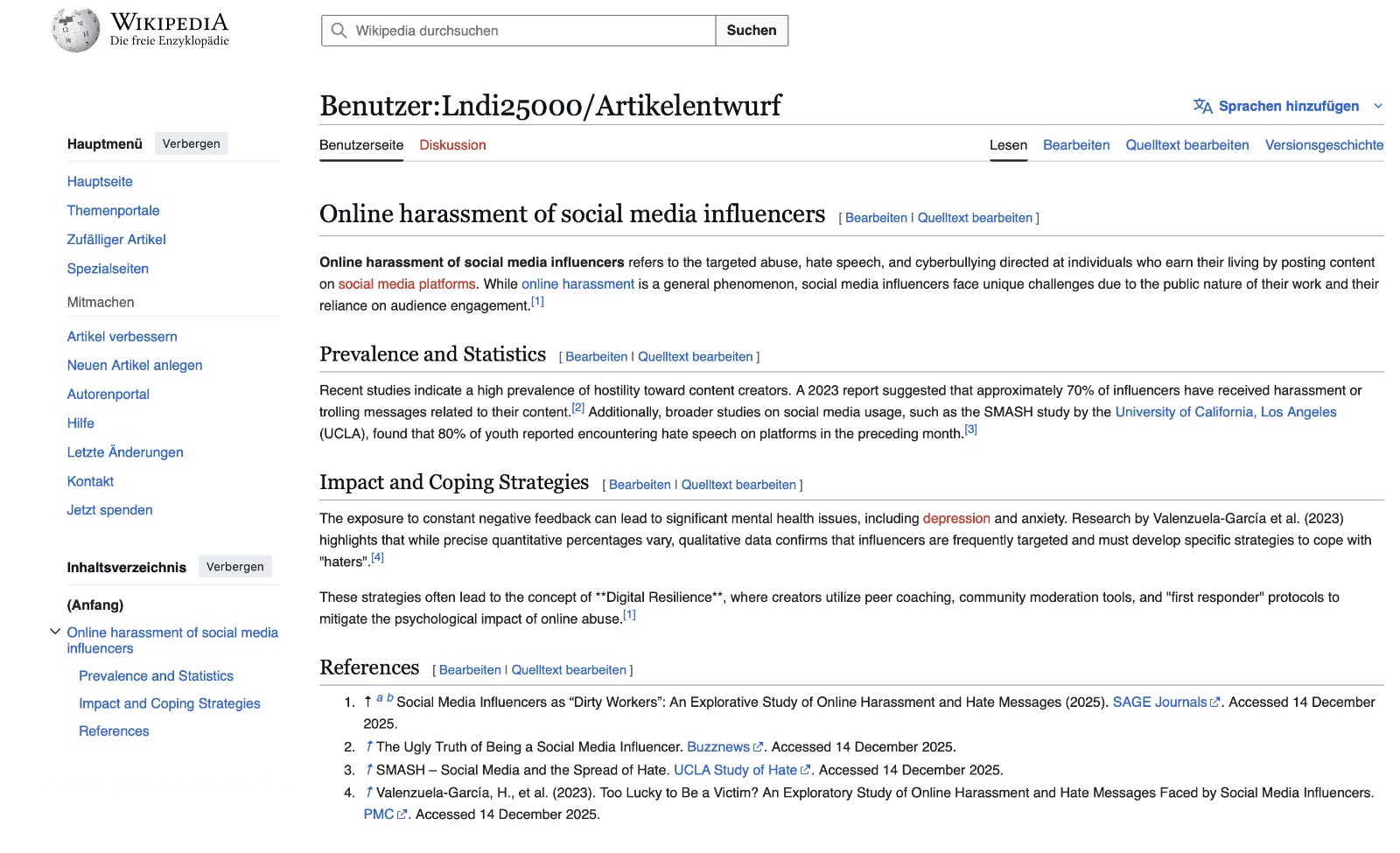
          Example Wikipedia article draft: Online harassment of social media influencers

          D. Stakeholder journey map

          A visual concept of content circulation: which stakeholders participate, which digital nudges encourage them, where participatory touchpoints occur, and which collective discussions and AI-mediated rolestorming they stimulate.

          E. A collective discussion

          A self-created AI plugin that simulates a collective discussion with the initiative’s most important stakeholders.

          AI-mediated stakeholder discussion

          Explore different stakeholder perspectives in a simulated collective discussion.

          Link coming soon

          Participatory digital initiative / community — one-page prototype

          Template One Pager HSG 2026_Group7

          Participatory digital initiative

          [Your initiative’s name]

          [A short introduction to the problem, the community involved and the change you want to make together.]

          A. Introductory visual comparison

          A visual comparison of what happens if the problem remains unaddressed or skewed by media misrepresentation, and what the initiative aims to change.

          B. The story of the initiative

          An emotionally resonant narrative about the community, the problem and the change the initiative makes possible. Use a video of approximately 3 minutes or a podcast of approximately 5 minutes.

          Video or podcast will appear here

          Video: approximately 3 minutes
          Podcast: approximately 5 minutes

          C. The concept behind the initiative

          A sketch of a Wikipedia article summarising a social science concept relevant to the initiative.

          Example Wikipedia article draft: Online harassment of social media influencers

          D. Stakeholder journey map

          A visual concept of content circulation: which stakeholders participate, which digital nudges encourage them, where participatory touchpoints occur, and which collective discussions and AI-mediated rolestorming they stimulate.

          E. A collective discussion

          A self-created AI plugin that simulates a collective discussion with the initiative’s most important stakeholders.

          AI-mediated stakeholder discussion

          Explore different stakeholder perspectives in a simulated collective discussion.

          Link coming soon

          Participatory digital initiative / community — one-page prototype

          Template One Pager HSG 2026_Group6

          Participatory digital initiative

          [Your initiative’s name]

          [A short introduction to the problem, the community involved and the change you want to make together.]

          A. Introductory visual comparison

          A visual comparison of what happens if the problem remains unaddressed or skewed by media misrepresentation, and what the initiative aims to change.

          B. The story of the initiative

          An emotionally resonant narrative about the community, the problem and the change the initiative makes possible. Use a video of approximately 3 minutes or a podcast of approximately 5 minutes.

          Video or podcast will appear here

          Video: approximately 3 minutes
          Podcast: approximately 5 minutes

          C. The concept behind the initiative

          A sketch of a Wikipedia article summarising a social science concept relevant to the initiative.

          Example Wikipedia article draft: Online harassment of social media influencers

          D. Stakeholder journey map

          A visual concept of content circulation: which stakeholders participate, which digital nudges encourage them, where participatory touchpoints occur, and which collective discussions and AI-mediated rolestorming they stimulate.

          E. A collective discussion

          A self-created AI plugin that simulates a collective discussion with the initiative’s most important stakeholders.

          AI-mediated stakeholder discussion

          Explore different stakeholder perspectives in a simulated collective discussion.

          Link coming soon

          Participatory digital initiative / community — one-page prototype

          Template One Pager HSG 2026_Group5

          Participatory digital initiative

          [Your initiative’s name]

          [A short introduction to the problem, the community involved and the change you want to make together.]

          A. Introductory visual comparison

          A visual comparison of what happens if the problem remains unaddressed or skewed by media misrepresentation, and what the initiative aims to change.

          B. The story of the initiative

          An emotionally resonant narrative about the community, the problem and the change the initiative makes possible. Use a video of approximately 3 minutes or a podcast of approximately 5 minutes.

          Video or podcast will appear here

          Video: approximately 3 minutes
          Podcast: approximately 5 minutes

          C. The concept behind the initiative

          A sketch of a Wikipedia article summarising a social science concept relevant to the initiative.

          Example Wikipedia article draft: Online harassment of social media influencers

          D. Stakeholder journey map

          A visual concept of content circulation: which stakeholders participate, which digital nudges encourage them, where participatory touchpoints occur, and which collective discussions and AI-mediated rolestorming they stimulate.

          E. A collective discussion

          A self-created AI plugin that simulates a collective discussion with the initiative’s most important stakeholders.

          AI-mediated stakeholder discussion

          Explore different stakeholder perspectives in a simulated collective discussion.

          Link coming soon

          Participatory digital initiative / community — one-page prototype

          Template One Pager HSG_Group4

          Participatory digital initiative

          [Your initiative’s name]

          [A short introduction to the problem, the community involved and the change you want to make together.]

          A. Introductory visual comparison

          A visual comparison of what happens if the problem remains unaddressed or skewed by media misrepresentation, and what the initiative aims to change.

          B. The story of the initiative

          An emotionally resonant narrative about the community, the problem and the change the initiative makes possible. Use a video of approximately 3 minutes or a podcast of approximately 5 minutes.

          Video or podcast will appear here

          Video: approximately 3 minutes
          Podcast: approximately 5 minutes

          C. The concept behind the initiative

          A sketch of a Wikipedia article summarising a social science concept relevant to the initiative.

          Example Wikipedia article draft: Online harassment of social media influencers

          D. Stakeholder journey map

          A visual concept of content circulation: which stakeholders participate, which digital nudges encourage them, where participatory touchpoints occur, and which collective discussions and AI-mediated rolestorming they stimulate.

          E. A collective discussion

          A self-created AI plugin that simulates a collective discussion with the initiative’s most important stakeholders.

          AI-mediated stakeholder discussion

          Explore different stakeholder perspectives in a simulated collective discussion.

          Link coming soon

          Participatory digital initiative / community — one-page prototype

          Template One Pager HSG 2026_Group3

          Participatory digital initiative

          THINK TWICE

          AI gives you answers. We help you question them.

          An essay deadline. An exam shortcut. A convincing claim. Which would you trust an AI with?

          Choose a case, make your first decision, and take it around a circle of students, educators, AI developers, and policymakers. Each Yes/No choice changes the next perspective you encounter.

          Your judgement stays at the centre. At the end, decide whether your original choice still holds—and what evidence would make you reconsider.

          Start with the comparison below, then try the interactive journey in section D. The current journey uses scripted cases; the video and separate AI Roundtable will be added later.

          A. Introductory visual comparison

          What changes when an AI answer becomes the start of a discussion? Compare two possible paths through the same situation: accepting an unchecked answer, or pausing to explain, verify, and discuss it.

          B. The story of the initiative

          An emotionally resonant narrative about the community, the problem and the change the initiative makes possible. Use a video of approximately 3 minutes or a podcast of approximately 5 minutes.

          Video or podcast will appear here

          Video: approximately 3 minutes
          Podcast: approximately 5 minutes

          C. The concept behind the initiative

          WIKIPEDIA
          The Free Encyclopedia

          Cognitive offloading

          Wikipedia-style educational prototype · THINK TWICE
          Article Read Educational prototype

          Cognitive offloading refers to the use of external tools or actions to reduce the cognitive demands of a task. Examples include writing reminders, taking notes and using digital technologies to access information. [1]

          1. Definition

          Cognitive offloading occurs when individuals use external resources to support cognitive processes. Rather than relying exclusively on internal memory, people may use physical or digital aids to manage information and tasks.

          2. Mechanisms and benefits

          Offloading can make demanding tasks easier by reducing the need to remember or process all information internally.

          Decisions about when to offload depend partly on task demands and people's assessments of their own abilities. These assessments can sometimes be inaccurate. [1]

          3. Application to generative AI

          Generative AI tools such as ChatGPT can support activities including drafting, summarizing and explaining information.

          In educational settings, students can use these tools to reduce the effort involved in particular cognitive tasks.

          THINK TWICE perspective: AI should support students' reasoning rather than replace their active engagement with information.
          4. Implications for critical thinking

          The implications of AI-assisted cognitive offloading depend on how the technology is used.

          Students may actively question and verify generated information, or they may accept outputs without sufficient reflection.

          THINK TWICE encourages users to compare perspectives, examine evidence and formulate independent conclusions.

          This is the initiative's proposed educational approach, not a causal finding established by the cited review.

          5. Limitations

          Cognitive offloading is not inherently harmful. External tools can provide valuable cognitive support.

          Their educational consequences depend on the task, the context and the way they are used.

          The existence of cognitive offloading alone does not establish that generative AI causes a decline in critical-thinking abilities.

          6. References

          [1] Risko, E. F., & Gilbert, S. J. (2016). Cognitive offloading. Trends in Cognitive Sciences, 20(9), 676–688. https://doi.org/10.1016/j.tics.2016.07.002

          This is a Wikipedia-inspired educational prototype created for the THINK TWICE initiative. It is not an official Wikipedia article.

          D. Stakeholder journey map

          Your choices take the conversation around the circle. Start with an essay deadline, exam preparation, or an unverified AI claim. Answer Yes or No as students, educators, AI developers, and policymakers challenge different parts of your decision. The highlighted role and step count show where you are.

          These are scripted perspectives, not live AI or real participant testimony. Your choices determine the route and final recap. There is no score or required opinion. On a small screen, use the activity’s fullscreen control.

          How participation becomes the next conversation

          Discover → choose → question → compare → deliberate → circulate. A student brings a dilemma; educators question what counts as understanding; developers explain the limits of fluent output; policymakers raise responsibility and transparency. The visitor weighs the disagreement, discusses a recommendation with a peer, and returns with an objection or a new case.

          Participation prompts: a concrete case makes starting easier; Yes/No choices reduce the effort of a first contribution; visible progress encourages completion; the final reflection asks for a reason and an invitation to disagree. These prompts support participation without claiming that an AI is more intelligent or inventing what other people believe.

          E. A collective discussion

          A self-created AI plugin that simulates a collective discussion with the initiative’s most important stakeholders.

          AI-mediated stakeholder discussion

          Explore different stakeholder perspectives in a simulated collective discussion.

          Link coming soon

          Participatory digital initiative / community — one-page prototype

          Template One Pager HSG 2026_Group2

          Participatory digital initiative

          [Your initiative’s name]

          [A short introduction to the problem, the community involved and the change you want to make together.]

          A. Introductory visual comparison

          A visual comparison of what happens if the problem remains unaddressed or skewed by media misrepresentation, and what the initiative aims to change.

          B. The story of the initiative

          An emotionally resonant narrative about the community, the problem and the change the initiative makes possible. Use a video of approximately 3 minutes or a podcast of approximately 5 minutes.

          Video or podcast will appear here

          Video: approximately 3 minutes
          Podcast: approximately 5 minutes

          C. The concept behind the initiative

          A sketch of a Wikipedia article summarising a social science concept relevant to the initiative.

          Example Wikipedia article draft: Online harassment of social media influencers

          D. Stakeholder journey map

          A visual concept of content circulation: which stakeholders participate, which digital nudges encourage them, where participatory touchpoints occur, and which collective discussions and AI-mediated rolestorming they stimulate.

          E. A collective discussion

          A self-created AI plugin that simulates a collective discussion with the initiative’s most important stakeholders.

          AI-mediated stakeholder discussion

          Explore different stakeholder perspectives in a simulated collective discussion.

          Link coming soon

          Participatory digital initiative / community — one-page prototype

          Template One Pager HSG 2026_Group1

          Participatory digital initiative

          [Your initiative’s name]

          [A short introduction to the problem, the community involved and the change you want to make together.]

          A. Introductory visual comparison

          A visual comparison of what happens if the problem remains unaddressed or skewed by media misrepresentation, and what the initiative aims to change.

          B. The story of the initiative

          An emotionally resonant narrative about the community, the problem and the change the initiative makes possible. Use a video of approximately 3 minutes or a podcast of approximately 5 minutes.

          Video or podcast will appear here

          Video: approximately 3 minutes
          Podcast: approximately 5 minutes

          C. The concept behind the initiative

          A sketch of a Wikipedia article summarising a social science concept relevant to the initiative.

          Example Wikipedia article draft: Online harassment of social media influencers

          D. Stakeholder journey map

          A visual concept of content circulation: which stakeholders participate, which digital nudges encourage them, where participatory touchpoints occur, and which collective discussions and AI-mediated rolestorming they stimulate.

          E. A collective discussion

          A self-created AI plugin that simulates a collective discussion with the initiative’s most important stakeholders.

          AI-mediated stakeholder discussion

          Explore different stakeholder perspectives in a simulated collective discussion.

          Link coming soon

          Participatory digital initiative / community — one-page prototype